🚀
Pitch Deck Template: The Ten Slides Investors Expect
A pitch deck tells investors, in about ten slides, the problem, the solution, why now, the market, the product, traction, the business model and competition, the team, and the ask with the use of funds.
Get these right
- 1Traction is the slide investors look for first; put real numbers on it.
- 2Size the market bottom-up: customers times price, not a percentage of a big number.
- 3Competition is a comparison on what customers care about, not a list of logos.
- 4The ask states the amount, the runway it buys and the milestones it reaches.
Structure
The deck opens with these slides, in this order.
- 1PitchTitle
- 2ProblemBullets
- 3SolutionBullets
- 4Why nowBullets
- 5MarketBullets
- 6ProductImage
- 7TractionBullets
- 8Business model and competitionTwo columns
- 9TeamBullets
- 10The askClosing
A complete example · 14 slides
Designed by the AI from this brief, exactly as the workbench would design yours:
A seed pitch for a startup that turns customer-support tickets into product bug reports automatically: problem: product teams miss bugs that customers report to support; solution: an AI layer that clusters tickets and files reproducible bug reports; why now: models can now read tickets reliably; market: 40,000 mid-size software companies in China and Southeast Asia, about 2,000 USD a year each; traction: 12 paying customers, 18,000 USD monthly recurring revenue, growing 15% a month; model: per-seat SaaS; competition: help-desk analytics tools that report trends but do not file bugs; team: ex-support lead and ex-engineering lead from a large e-commerce company; ask: 1.5 million USD for 18 months to reach 1 million USD ARR.
[company]
Every customer-reported bug, filed automatically | Seed round, [date]
The opportunity
Why bugs get lost between support and product
2 / 14
Product teams miss the bugs customers already reported
- •Customers describe bugs to support, not to engineering
- •Support closes tickets with workarounds and the root cause stays open
- •Product teams read dashboards of trends, not reproducible reports
- •Repeat tickets pile up while the same defect ships again
- •Manual triage costs [figure needed] support hours per month
3 / 14
An AI layer that files reproducible bug reports from tickets
- •Reads every incoming support ticket as it arrives
- •Clusters tickets that describe the same underlying defect
- •Extracts steps to reproduce, environment and impact
- •Files a ready-to-work bug report in the engineering tracker
- •Links each report back to the affected customers
4 / 14
Why now: models can finally read tickets reliably
- •Current language models parse messy customer text with high accuracy
- •Clustering by root cause was not feasible with keyword tools
- •Help desks and trackers now expose stable APIs for integration
- •Support volumes are rising faster than engineering headcount
- •Teams expect AI in the workflow, not in a separate dashboard
5 / 14
A 40,000-company market worth about 80M USD a year
- •40,000 mid-size software companies in China and Southeast Asia
- •About 2,000 USD a year each in annual contract value
- •Addressable market of roughly 80M USD per year
- •Expansion into other regions and larger accounts not yet counted
- •Per-seat pricing grows with each customer's team size
6 / 14
Product and traction
What we have built and who pays for it
7 / 14
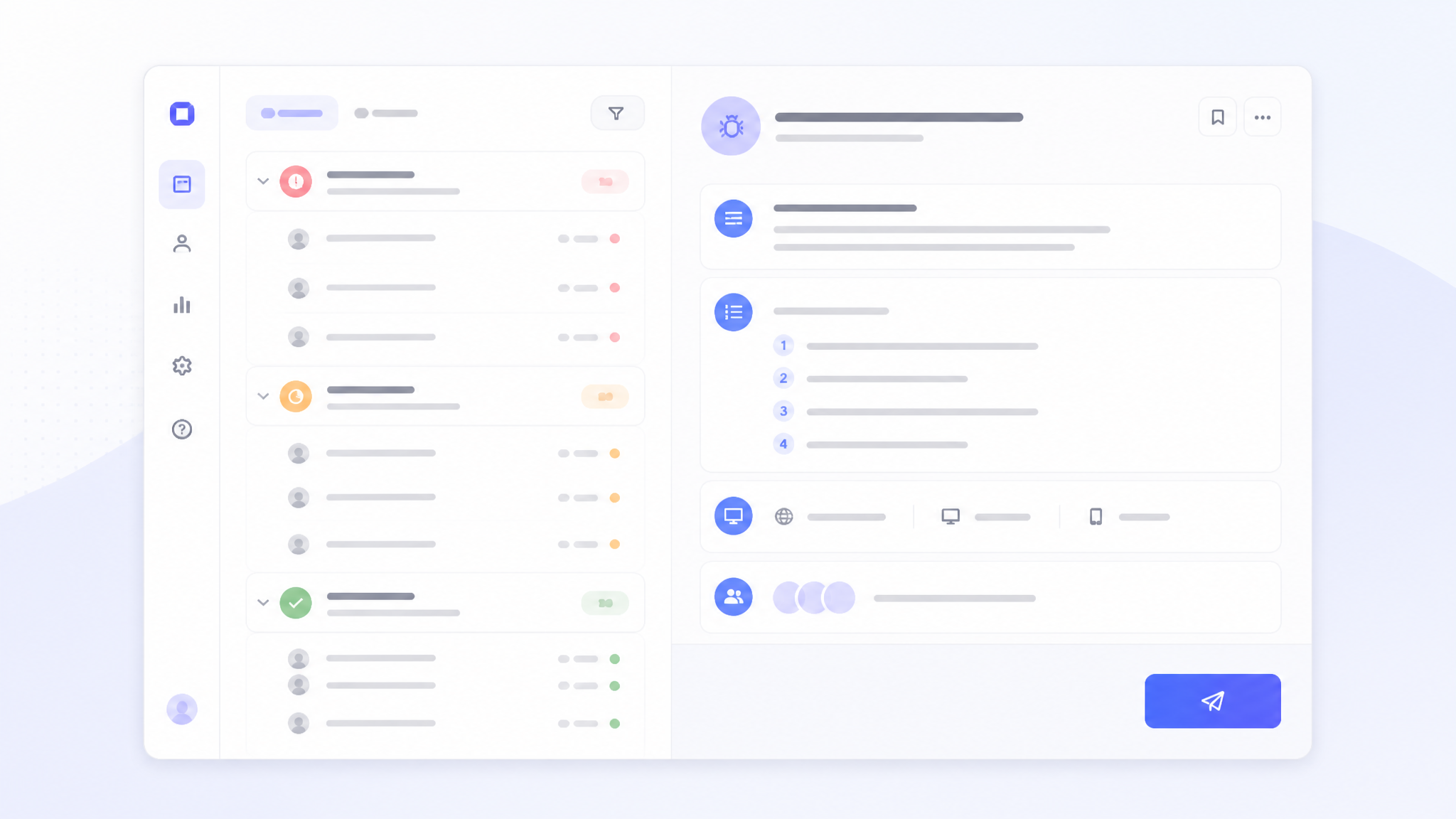
From ticket cluster to bug report in one view
- •Left: clustered support tickets describing one defect
- •Right: the generated bug report with steps to reproduce
- •One click files the report to the engineering tracker
8 / 14
12 paying customers and 18,000 USD MRR, growing 15% a month
- •12 paying customers at 18,000 USD monthly recurring revenue
- •Revenue growing 15% month over month
9 / 14
The business
How we charge, who we compete with, who we are
10 / 14
Per-seat SaaS against tools that report trends but do not file bugs
Business model
- •Per-seat SaaS subscription
- •Priced for mid-size product and support teams
- •Revenue scales with seats as teams grow
- •Low-touch onboarding through help-desk integrations
Competition
- •Help-desk analytics tools report ticket trends
- •They surface patterns but leave filing to humans
- •No reproducible bug reports in the tracker
- •We close the loop from ticket to fix
11 / 14
Founders who lived both sides of the problem
- •Former support lead at a large e-commerce company
- •Former engineering lead at the same company
- •Together they owned the ticket-to-bug handoff at scale
- •Early engineering hires: [figure needed]
- •Advisors: [figure needed]
12 / 14
Raising 1.5M USD to reach 1M USD ARR in 18 months
Use of funds: engineering, go-to-market, integrations | [contact]
13 / 14
Thank you
[company] | [contact email]
14 / 14
Names, figures and dates in the example are made up for illustration; pictures were generated.
How it works
- 1Open the template: a deck with this structure and the brief appears.
- 2Add one line about your case, or attach your notes, spreadsheets or recordings as sources, and press First draft.
- 3Edit any slide yourself, or ask the AI to tighten it, chart its figures, add a picture or reorder the deck; download .pptx when it is ready.
Questions
- Does the .pptx open in PowerPoint, Keynote and WPS?
- Yes. Text, bullets, pictures and speaker notes are ordinary PowerPoint objects, and charts are native charts you can edit there.
- Can I use the example as it is?
- The example shows the shape; its names and figures are made up. Open the template and give the AI your own facts, and it designs yours in the same shape.
- Is it free?
- Writing is billed by the tokens used, usually a few credits per deck; a generated picture is 4 credits; the template, the editor and the download cost nothing.
Other kinds of deck
AI PPT generator →Document to PPT →Everyday documents →📊Work reportResults, problems, next steps, asks — for a manager or a committee.🧭Project proposalWhy, what, how, how much, by when — to get a yes.📦Product introductionWho it is for, what it does, why it is better, how to get it.🎓Training deckObjectives, concepts, examples, practice, summary.🗓️Year in reviewThe year in numbers, what worked, what did not, next year.